Malabar Hill
Around the World in Eighty DaysMalabar Hill enters the novel through its pagoda, a conspicuous Bombay landmark that Phileas Fogg deliberately ignores but Passepartout impulsively enters. The contrast makes the place more than a feature of the city’s scenery: it is where the travelers’ carefully timed itinerary collides with religious practice and colonial law. Passepartout’s unplanned visit ends in a beating, a lost pair of shoes, and a prosecution that identifies the pagoda by name and makes the shoes material evidence of his presence.
A landmark outside Fogg’s itinerary
The pagoda stands among the sights of Bombay that Fogg declines to see. After leaving the Mongolia, he says goodbye to his whist partners, gives Passepartout errands, insists that he be at the station by eight, and goes to the passport office. His regular step is compared to an astronomical clock; the city’s attractions do not alter his schedule. The pagoda on Malabar Hill is described as noble and as having two polygonal towers, but it holds no interest for him. He likewise refuses to examine the works at Elephanta, the hypogea south-east of the docks, or the Buddhist remains in the Kanherian grottoes of Salcette. The catalogue places the pagoda within a wider field of celebrated sites that Fogg treats as irrelevant to the journey’s timetable.
Passepartout responds to Bombay differently. After buying shirts and shoes, he wanders among crowds that the narrative identifies by nationality, dress, and community. He encounters a Parsee festival, where processions and performances draw his attention, and watches as the celebration moves away. On his return towards the station, the pagoda catches his eye and his curiosity takes him inside. The detour grows from the same city that Fogg has reduced to a transit point: for the servant, its public life and religious buildings invite attention, while the master measures the visit against departure time.
The visit and its immediate cost
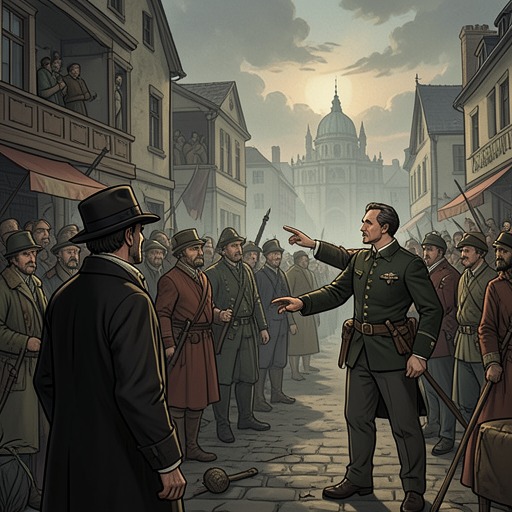
Passepartout does not know that Christians are forbidden to enter certain Indian temples, or that even worshippers must remove their shoes before going in. The account also states that the British Government severely punishes disregard for native religious practices. He enters without intending harm and admires the Brahmin ornamentation, but then finds himself sprawled on the sacred flagging. Three priests attack him, tear off his shoes, and beat him. He gets to his feet, knocks two of them down with his fists and feet, and escapes the third by mingling with the street crowd.
The encounter changes the practical meaning of the pagoda in the travel narrative. It is first one of Bombay’s sights, then the setting of a conflict that costs Passepartout his shoes and the package containing his newly purchased shirts and shoes. With only five minutes to spare before eight, he rushes into the station hatless and shoeless. The episode thus puts his impulsiveness against the exact schedule Fogg has set: the landmark is not visited as an excursion successfully completed, but as a detour whose consequences travel onward with the party.
From sacred site to courtroom evidence
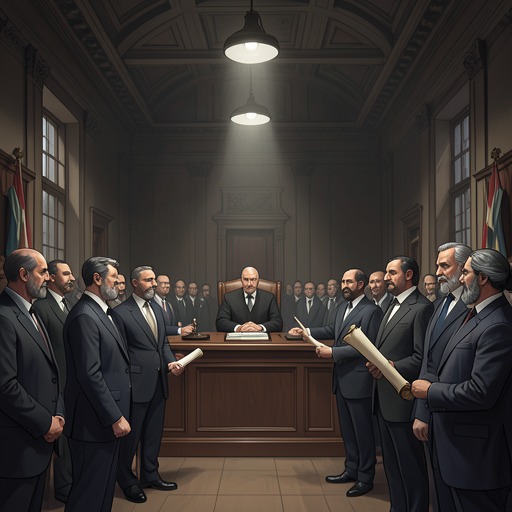
The pagoda returns in the Calcutta proceedings, where its precise identity matters. Three Indian priests bring a complaint accusing Phileas Fogg and Passepartout of violating a place consecrated by the Brahmin religion. Passepartout initially mistakes the accusation for a reference to the Pagoda of Pillaji, associated with the earlier rescue of a young woman. The judge corrects him: the case concerns the pagoda on Malabar Hill in Bombay. The clarification distinguishes two separate sites and connects the Bombay visit to a legal charge rather than to the later events at Pillaji.
The shoes Passepartout left behind become the prosecution’s proof of the desecrator’s identity. In Bombay they were taken from him during the priests’ attack; in court they are placed on the clerk’s desk as evidence. That reversal gives an ordinary travel possession a specific narrative function: the object that marks his hurried escape also ties him to the site. Fogg admits the facts, and the judge sentences Passepartout to fifteen days’ imprisonment and a fine of three hundred pounds for violating the pagoda on 20 October.
Religious practice and the novel’s route
The court’s stated rationale is that English law protects the religions of the Indian people equally and sternly. That assertion sits beside the travelers’ experience of an unfamiliar rule, the priests’ immediate enforcement of the temple boundary, and the complaint’s formal passage through a colonial courtroom. The pagoda is therefore represented both as a sacred space governed by practices Passepartout does not understand and as a place whose violation can be translated into a prosecutable offence. The account does not treat his ignorance as permission: the legal consequence follows from the admitted entry, while the shoes make the incident legible to the court.
As a point on the route, Malabar Hill is a brief diversion from Fogg’s timed passage through Bombay; as a plot location, it generates an afterlife beyond the visit itself. The initial contrast between Fogg’s indifference and Passepartout’s curiosity becomes a contrast between planned movement and unexpected arrest. The pagoda’s name resurfaces when the court separates it from Pillaji, and its lost shoes resurface as evidence. Through those returns, a landmark first presented among the city’s attractions becomes the origin of a legal interruption in the travelers’ onward journey.